
From Jewish Folk Poetry
by Sára Gutvill
Shostakovich initially wrote his song cycle From Jewish Folk Poetry for three singers and piano in 1948: just a few months after the Central Committee of the Communist Party condemned “cosmopolitanism” in arts, and his music was pronounced “worthless” and “fallacious”, and just a few months before Solomon Mikhoels, head of the Jewish Anti-fascist Committee was murdered. The story and the timing of the cycle leave us with many questions: Was the composition of the Jewish cycle an act of protest and solidarity with the Jewish people in times of growing Anti-Semitism? Or was it, on the contrary, an attempt of the composer to write the music the Party expected from him: easily accessible to the listener, melodious, rich in stories and literary images? Was Shostakovich’ interest in Jewish culture politically motivated or was he just looking for a musical heritage that would set his imagination in motion? And how shall we interpret the obvious break in the cycle after the 8th song? While the first 8 songs, written in August 1948 deal with hardship and human tragedies, the last three, dated in October of the same year, are optimistic and praising the happy life in the Soviet Union – a first glance at the titles reveals the chasm. Was this an attempt to make a publication of the cycle possible?
After the 8 songs ware performed during an informal gathering honoring Shostakovich’ birthday in September 1948 and he finished the last 3 songs in October of the same year, the songs disappeared in the drawer to be publicly performed only in 1955 – two years after Stalin’s death. The orchestral version followed in 1964. While the orchestral version is naturally richer in musical texture, the piano version does more justice to the intimacy of the original folk songs.
Although Shostakovich sat Russian translations, we know he was asking for help in pronouncing Yiddish in spring 1948. Was he at first looking at other – Yiddish – texts with the intention of setting them? Did he have the original Yiddish texts of the Russian translations he later set to music? Was Joachim Braun right when – quoting, Shostakovich’ son – he claimed that the composer intended the songs could be sung in Yiddish as well?
Most of these questions are impossible to answer 60 years later.
We however were up to an experiment: Paying tribute to the research of Joachim Braun who found and published the Yiddish texts of all 11 songs, we wanted to try out the settings in Yiddish. We found this very rewarding: the Yiddish language has its special flavor and many of its expressions add a semantic richness to the songs that are lost in the Russian translation.
With the cycle in the center of the program we chose to surround its pieces with the traditional settings of the same texts as well as compositions by Viktor Ullmann, Darius Milhaud and Maurice Ravel. The Shostakovich settings are in an interesting contrast to the traditional songs: cheerful love songs turn into bitter songs of separation, lullabies into dialogues, fathers disappear in Siberia instead of waiting for their families in America.
A kaleidoscopic landscape opens up when we begin our journey into Soviet Yiddishland, inhabited by parting lovers, weeping mothers and rebellious daughters, joyful kolkhozniks, spiders in cribs and goats on the roof. I hope you will enjoy the ride as much as we do!
From Jewish Folk Poetry A Song Cycle translated by Laurence R. Richter
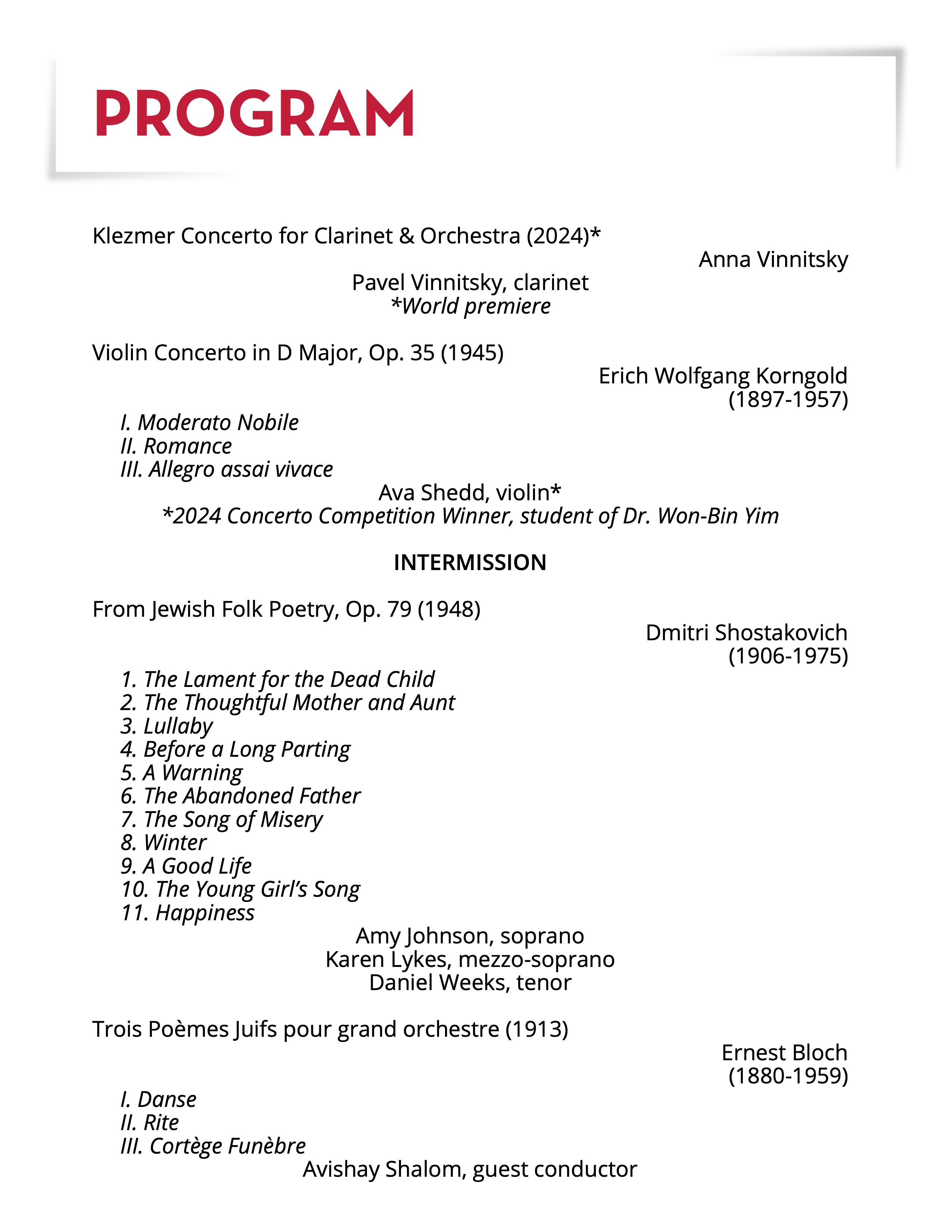
1. The Lament for the Dead Child
Russian translation by T. Spendiarova
Sun and rain, daylight and darkness.
A mist has fallen, the moon has grown dim.
Cont: Who did she give birth to?
Sop:A boy, a boy.
Cont: And what did they name him?
Sop: Moishel, Moishele.
Cont: And what did they rock Moishele in?
Sop: In a cradle.
Cont: And what did they feed him?
Sop: Bread and onions.
Cont: And where di they bury him?
Sop: In the grave.
Oy, the boy’s in the grave, Michele’s in the grave. Oy!
2. The Thoughtful Mother and Aunt
Russian translation by A. Globa
Cont: Bye, bye, off to the village, Daddy, go! Bring us apples for our eyes? Bye…
Sop: Bye, bye, off to the village, Daddy, go! Bring us a chicken for our teeth! Bye…
Cont: Bye, bye, off to the village, Daddy, go! Bring us a duck for our chest! Bye…
Sop: Bye, bye, off to the village, Daddy, go! Bring us a goose for our tummy! Bye…
Cont: Bye, bye, off to the village, Daddy, go! Bring us some sunflower seeds for our scalp!
Bye, Bye, off to the village, Daddy, go!
Bring us a rabbit for our fingers! Bye… Bye…
3. Lullaby
Russian translation by V. Zvyagintseva
My little boy, you’re the most beautiful baby in the world, a light in the darkness!
Your father is in chains in Siberia, where the Tsar holds him in prison.
Sleep! Lullay, lullay.
As she rocks your cradle, Mama sheds bitter tears.
You will understand when you grow up what it is that sears her heart.
Your father is far off in Siberia, and I must endure poverty.
Sleep for now without cares, ah, lullay, lullay.
My grief is blacker than the very night! Sleep, although I cannot.
Sleep, my fine boy, sleep, my little son, sleep! Lullay, lullaby…
4. Before a Long Parting
Russian translation by A. Globa
Sop: Oy, Abram, how am I to live without you?
Me without you, you without me – how are we to live apart?
Ten: Do you remember that time, we stood at the gate –
Remember what you said to me in secret?
Oy, Rivochka, kiss me, girl!
Sop: Oy, Abram, how are we to live now?
Me without you, you without me – oy, like a door without a doorknob!
Ten: Remember our walks, just the two of us?
Remember what you said to me on the boulevard?
Sop: Oy! Oy!
Ten: Oy, Rivochka, kiss me, girl!
Sop: Oy Abram,
Ten: Oy Rivochka
How am I to live without you!
Me without you, you without me, how are we to live without happiness?
Sop: Do you remember the red skirt I used to wear?
Oy, how beautiful I was then!
Oy, Abram! Oy Abram!
Ten: Oy, Rivochka, kiss me, girl!
5. A Warning
Russian translation by N. Ushakov
Listen, Hasya, you can’t go running around, don’t you dare do it,
Running around with just anyone! Be careful!
If you go running around, staying out until morning, oy,
Later on you’ll be crying your eyes out, Hasya! Listen to me, Hasya!
6. The Abandoned Father
Russian translation by S. Mar
Cont: Ele, the old-clothes man, put on his coat.
People were saying that his daughter had gone off to the policeman’s place.
Ten: Tsirele, daughter, come back to your father.
I’ll give you some fancy dresses for your wedding.
Tsirele, daughter, I’ll buy you earrings and rings, I promise.
Tsirele, daughter, I’ll even include a handsome young man for you in the bargain. Tsirele, daughter!
Cont: I don’t need your fancy clothes, and I don’t need your rings.
And Mister Policeman is the only man I will marry.
Mister Policeman, please hurry,
Send this old Jew Packing!
Ten: Tsirele, daughter, come back to me!
Tsirele, daughter, come back to me!
Oy, come back to me, come back! Tsirele, daughter!
7. The Song of Misery
Russian translation by B. Semenov
The roof sleeps on the attic, sound asleep under the straw.
In the cradle my baby sleeps, without-diapers, stark naked!
Hop, hop, higher, higher! The goat is eating the straw right off the roff.
Hop, hop, higher, higher! The goat is eating the straw right off the roof. Oy!
Now the cradle is in the attic, and a spider in it is weaving trouble.
It’s devouring all my happiness, leaving me only want.
Hop, hop, higher, higher! The goat is eating the straw right off the roof.
Hop, hop, higher, higher! The goat is eating the straw right off the roof. Oy!
There’s a rooster in the attic with a bright red cock’s comb.
Oy, wife, borrow at least a crust of stale bread for the kids!
Hop, hop, higher, higher! The goat is eating the straw right off the roof.
Hop, hop higher, higher! The goat is eating the stray right off the roof. Oy!
8. Winter
Russian translation by B. Semenov
Ten: My Sheindl is lying in the bed, holding our sick child.
There’s not even a wood chip in this unheated hut, and wind is howling outside. Ah!
The hoarfrost and the wind have come back, and I can’t bear to endure it in silence.
Cry out, children, weep! Winter is back again! Ah!
9. A Good Life
Russian translation by S. Olender
About our spacious fields, dear friends,
I never sang songs in those dead years of the past.
The fields didn’t ripen for me,
The dew didn’t glitter for me.
In a cramped cellar, in dank darkness,
I lived then, tormented by need.
And my sad song arose from the cellar,
A song of unhappiness, of unending torments.
Collective-farm creek, flow ever more merrily.
Rush my hearty greeting to all my friends.
Tell them that the collective farm is my home now,
And a flowering tree stands at my window.
Now the fields do ripen for me.
I’m fed milk and honey!
I am happy. And do tell my brothers:
I will spend my days composing songs to the beauty of the collective-farm fields!
10. The Young Girl’s Song
Russian translation by S. Olender
On a grassy area beside the always wistful woods,
We shepherd the collective farm’s flocks from morning till night.
As I sit on a hillock with my whistle beside me
I can’t take in all the boundless beauty of my country.
The trees in their bright green finery are beautiful and shapely;
And in the fields the ripe ears of grain are lovely to see!
Oy, oy, oy, lullay, lullay, lullay…
First a tree-branch will smile at me, then an ear of grain will give me a wink.
Then a feeling of great joy will flash in my heart like a flame.
Sing on, my little whistle! How well we get along together!
The mountains and the valleys all hear our joyful song!
Just don’t be sad, little whistle, don’t weep. Forget the sorrow of the past,
And may your melodies fly away into the lovely distance.
Oy, oy, oy, oy, lullay, lullay, lullay…..
I am happy on my collective farm. Jest listen to how overflowing my life is now!
You must sing a happy song, little whistle, happier and happier!
11. Happiness
Russian translation by L. Dligach
Cont: I took my husband boldly by the arm.
So what if I’m old, and so is my boyfriend!
I led him off to the theater
And bought us two tickets for the main floor.
As we sat there until late at night,
We just gave ourselves over to happy dreams.
What blessings surround
The wife of a Jewish cobbler!
Tutti: Oy, oy, what blessings surround
The wife of a Jewish cobbler! Oy!
Cont: And now I’d like to let the whole country know
About my joyful, brilliant good fortune:
Our sons have become doctors!
And a star shines over our head!
Tutti: Oy, oy, a star shines over our head!
Our sons have become doctors!
And a star shines over our head! Oy!

 Cincinnati Arts & Cultural Exchange